This is Part 2 of a 5-part series on building production-grade distributed job processing systems in Rust using PostgreSQL.
The Challenge of Concurrent Dequeuing
Imagine ten workers all trying to grab the next job from a queue at the exact same moment. Without proper coordination, you get chaos:
- Race Conditions: Multiple workers grab the same job
- Blocking: Workers wait in line for locks, killing throughput
- Starvation: Some workers never get work while others hog everything
Traditional solutions involve external coordinators, distributed locks, or message brokers. But PostgreSQL gives us something elegant: FOR UPDATE SKIP LOCKED.
Understanding SKIP LOCKED
The magic lies in three words: skip locked rows. When a transaction locks a row with FOR UPDATE, that row becomes invisible to other transactions using SKIP LOCKED. No blocking, no waiting—just graceful skipping.
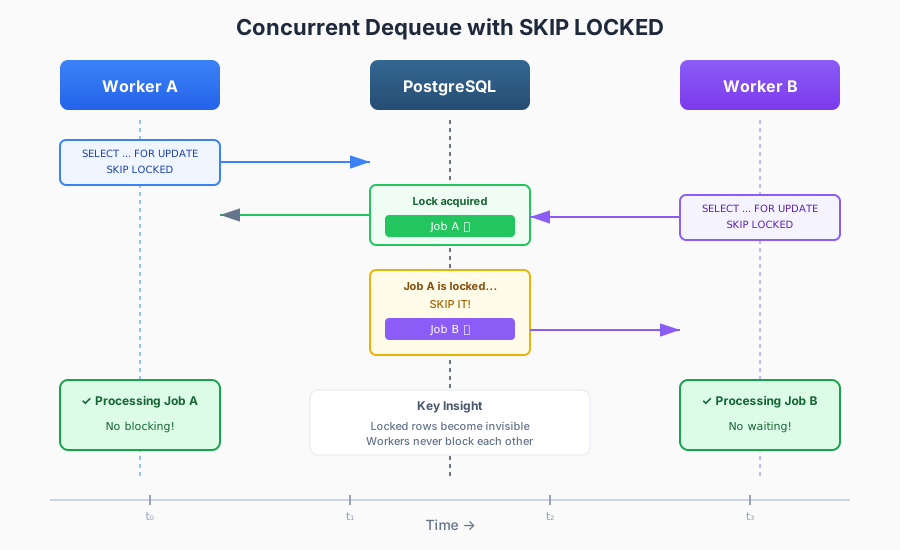
Here’s the mental model:
- Worker A executes
SELECT FOR UPDATE SKIP LOCKEDand locks Job #1 - Worker B executes the same query milliseconds later
- Instead of blocking on Job #1, Worker B’s query skips it entirely and returns Job #2
- Both workers proceed without any coordination overhead
The Atomic Dequeue Query
Our dequeue operation does four things in a single atomic query:
- Select the highest-priority pending job
- Lock it to prevent other workers from seeing it
- Create an execution record for audit/debugging
- Update the job status to “running”
Here’s the actual SQL using Common Table Expressions (CTEs):
WITH selected_job AS (
    -- Step 1: Find and lock the best available job
    SELECT id FROM jobs
    WHERE status = 'pending'
      AND scheduled_at <= NOW()
      AND attempts < max_attempts
      AND queue_name = ANY($3)    -- Filter by queue names
    ORDER BY priority DESC, scheduled_at ASC
    FOR UPDATE SKIP LOCKED
    LIMIT 1
),
execution AS (
    -- Step 2: Create execution record
    INSERT INTO job_executions (job_id, worker_id, started_at, status)
    SELECT id, $1, NOW(), 'running'
    FROM selected_job
    RETURNING id as execution_id, job_id
),
dequeued AS (
    -- Step 3: Update job to running state
    UPDATE jobs
    SET status = 'running',
        locked_by = $1,
        current_execution_id = execution.execution_id,
        lease_expires_at = NOW() + $2 * INTERVAL '1 second',
        attempts = attempts + 1
    FROM execution
    WHERE jobs.id = execution.job_id
    RETURNING jobs.*
)
SELECT * FROM dequeued
Breaking Down the Query
The SELECT with SKIP LOCKED
SELECT id FROM jobs
WHERE status = 'pending'
  AND scheduled_at <= NOW()          -- Respect scheduled time
  AND attempts < max_attempts         -- Don't retry exhausted jobs
  AND queue_name = ANY($3)           -- Queue filtering
ORDER BY priority DESC, scheduled_at ASC
FOR UPDATE SKIP LOCKED
LIMIT 1
The ordering is critical: priority DESC ensures high-priority jobs jump the queue, while scheduled_at ASC provides FIFO ordering within the same priority level.
The Execution Record
INSERT INTO job_executions (job_id, worker_id, started_at, status)
SELECT id, $1, NOW(), 'running'
FROM selected_job
RETURNING id as execution_id, job_id
This creates an audit trail. If the job fails, we’ll update this record with error details. The execution history becomes invaluable for debugging production issues.
The Status Update
UPDATE jobs
SET status = 'running',
    locked_by = $1,
    current_execution_id = execution.execution_id,
    lease_expires_at = NOW() + $2 * INTERVAL '1 second',
    attempts = attempts + 1
FROM execution
WHERE jobs.id = execution.job_id
Note the lease_expires_at field—this is crucial for reliability. If the worker crashes, we need to know when it’s safe to reclaim the job. We’ll explore this in Part 3.
Rust Implementation
Here’s how we wrap this query in Rust using sqlx:
pub async fn dequeue_job(
    &self,
    worker_id: &str,
    lease_duration_seconds: i64,
    queue_names: &[String],
) -> Result<Option<Job>> {
    let job = sqlx::query_as::<_, Job>(DEQUEUE_JOB_SQL)
        .bind(worker_id)
        .bind(lease_duration_seconds)
        .bind(queue_names)
        .fetch_optional(&self.pool)
        .await?;

    Ok(job)
}
The beauty of this approach:
- One round trip: Everything happens in a single database call
- Atomic: No partial states possible—the job is either dequeued or not
- Non-blocking: Workers never wait for each other
- No external coordination: PostgreSQL handles all the locking
Performance Considerations
Indexing is Critical
For the SKIP LOCKED query to perform well, you need proper indexes:
CREATE INDEX idx_jobs_pending ON jobs (
    priority DESC,
    scheduled_at ASC
)
WHERE status = 'pending';
This partial index only covers pending jobs, keeping it small and fast even as your completed job count grows.
Connection Pooling
Each dequeue operation holds a brief lock. With proper connection pooling (we use sqlx with configurable pool size), you can support hundreds of workers without connection exhaustion.
Queue Partitioning
The queue_name = ANY($3) filter lets workers specialize. You might have:
criticalqueue: Fast workers, small jobs, high prioritybulkqueue: Fewer workers, large batch jobsscheduledqueue: Cron-like scheduled tasks
Workers can subscribe to multiple queues with priority ordering.
When SKIP LOCKED Isn’t Enough
While SKIP LOCKED handles concurrent dequeuing beautifully, it doesn’t solve everything:
- Worker Crashes: What if a worker grabs a job and dies?
- Long-Running Jobs: How do we know a job is still being processed?
- Split Brain: What if a “dead” worker comes back to life?
These scenarios require additional mechanisms: leases, heartbeats, and execution ID verification. We’ll tackle these in Part 3.
Summary
SELECT FOR UPDATE SKIP LOCKED transforms PostgreSQL into an efficient job queue by:
- Eliminating blocking: Workers skip locked rows instead of waiting
- Ensuring fairness: Each job goes to exactly one worker
- Enabling atomicity: Dequeue, record, and update in one operation
- Scaling horizontally: Add workers without coordination overhead
The key insight is that we’re leveraging PostgreSQL’s battle-tested concurrency primitives instead of building our own distributed coordination layer.
Continue to Part 3: Reliability Through Leases & Heartbeats